On the ground and in the air, we Keep Climbing: Delta’s year of sustainability progress
Delta made meaningful progress toward its decarbonization goals in 2025, including investing in next-generation aircraft, improving operational efficiency and scaling sustainable aviation fuel (SAF).

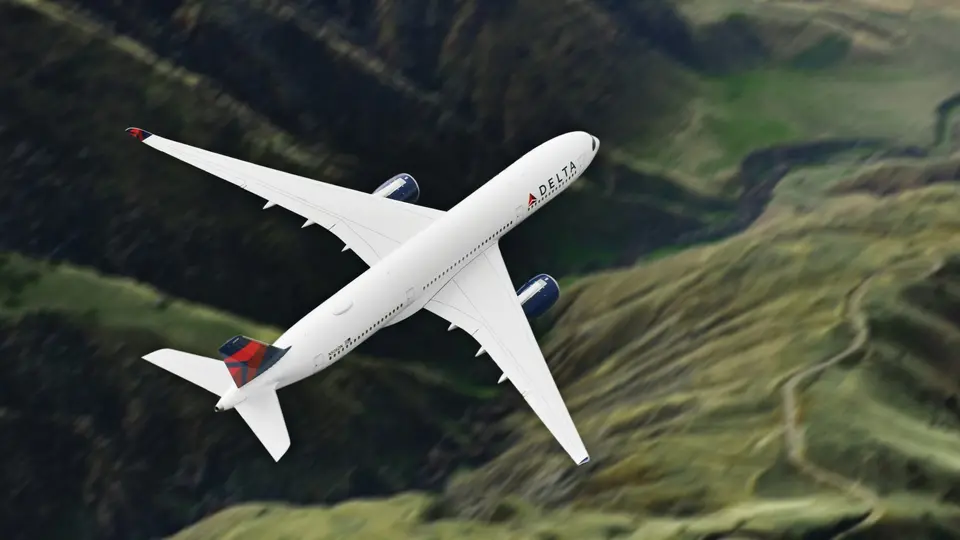
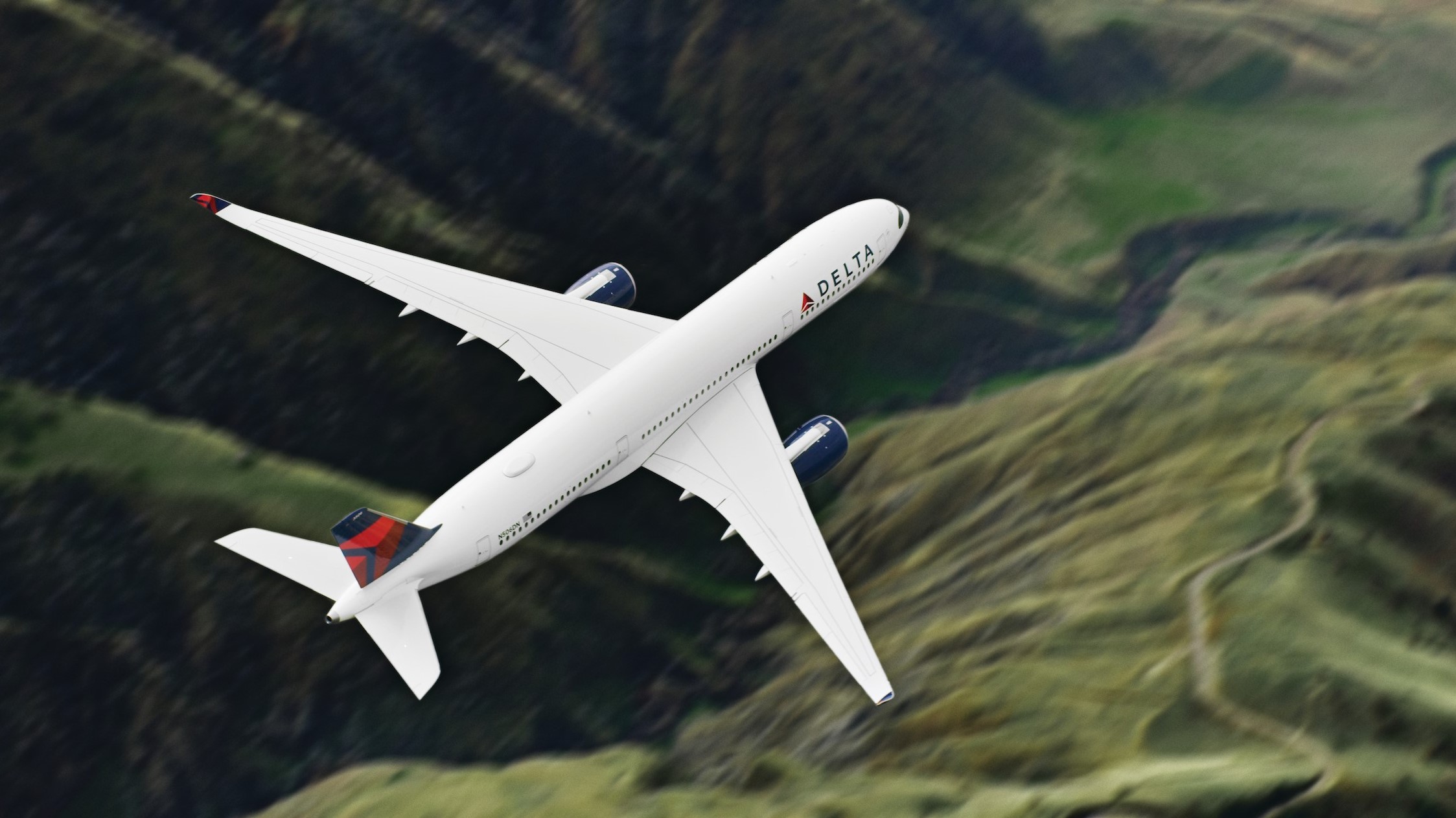
Delta’s sustainability strategy is built on three pillars: “What We Fly, How We Fly, and The Fuel We Use.” As the global airline closes out its centennial year, Delta made meaningful progress across all three, including investing in next-generation aircraft, improving operational efficiency and scaling sustainable aviation fuel (SAF). These milestones reflect Delta’s ongoing commitment to transforming the future of flight and achieving net-zero emissions by 2050, and were instrumental in driving cost savings for the company.
Check out the progress Delta made toward its decarbonization goals this year:
WHAT WE FLY

Partnering with revolutionary tech players to advance more fuel-efficient aircraft
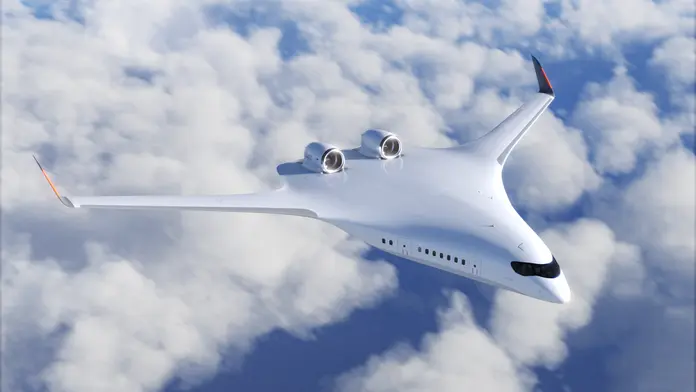
Delta announced a new partnership with JetZero to accelerate the development of JetZero’s blended wing-body (BWB) aircraft, a design that is expected to be up to 50% more fuel efficient than aircraft in operation today.
Delta is providing its best-in-class operational expertise through its Sustainable Skies Lab to bring the BWB aircraft to commercial viability as part of the global carrier’s work toward net-zero emissions by 2050. Delta will also consult on the interior design to re-invent and further elevate both customer and employee experiences.
Delta’s revolutionary fleet portfolio continued to grow in 2025. Delta also announced a new partnership with Maeve Aerospace to advance the development of Maeve’s hybrid electric aircraft for regional flights. Compared to today's regional aircraft designs, Maeve's aircraft design aims to reduce fuel consumption and emissions by up to 40% using conventional jet fuel, with further lifecycle emissions reductions possible when using SAF.
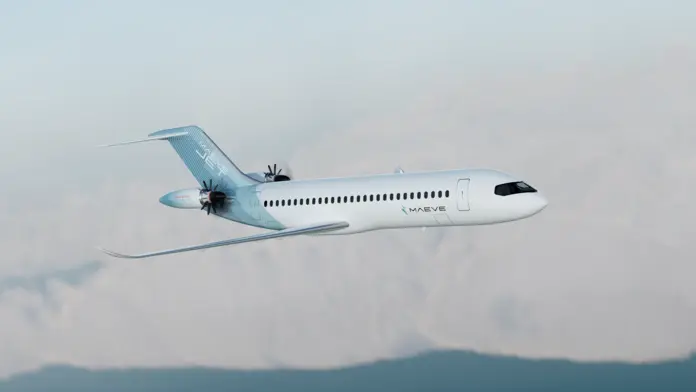
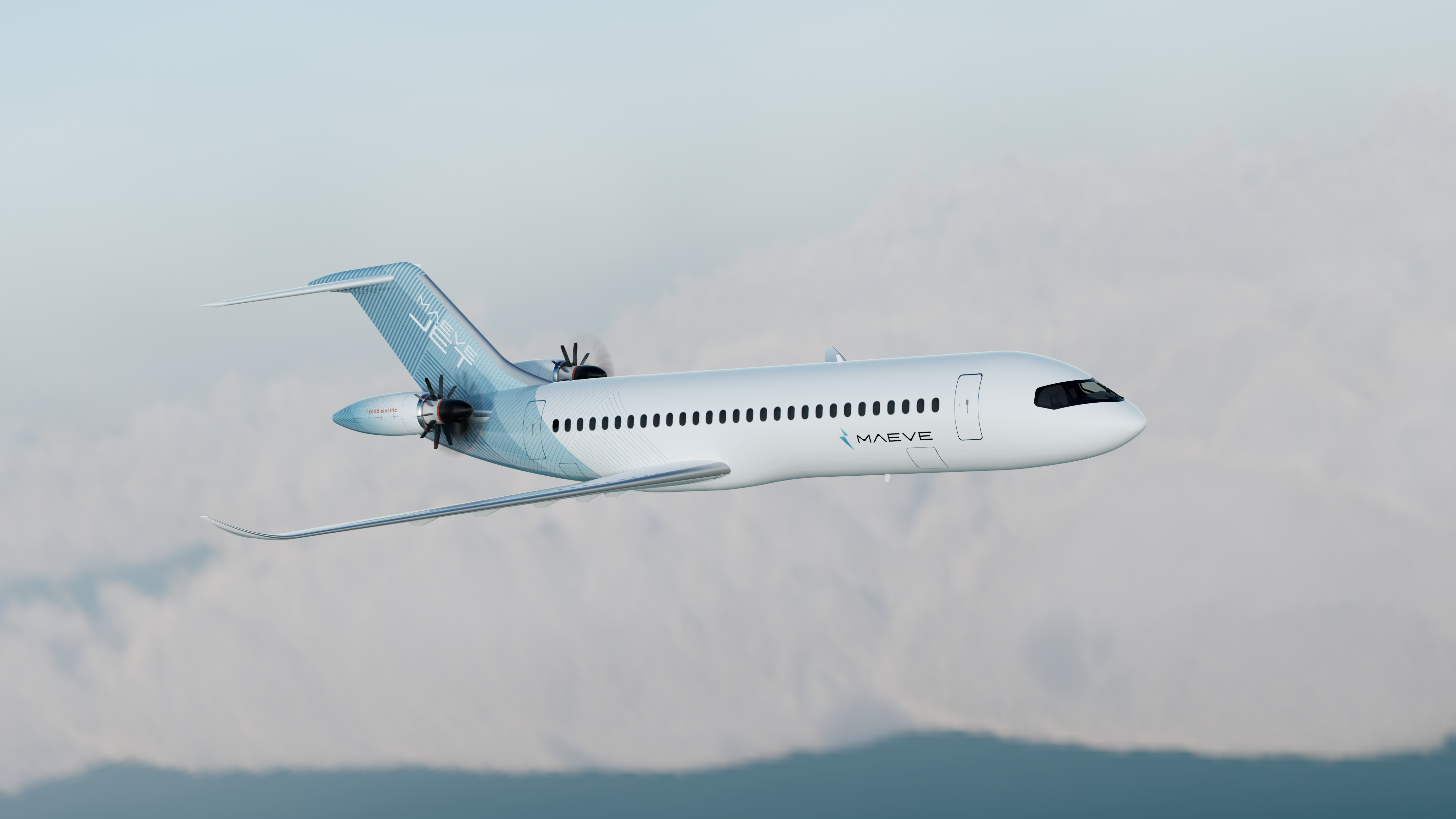
Maeve joins Delta’s Sustainable Skies Lab as the fifth revolutionary fleet partner, advancing a key milestone in Delta’s 2023 Sustainability Roadmap to accelerate innovative solutions for a more sustainable future of travel.
As a regional, hybrid-electric solution, Maeve’s exclusive partnership with Delta’s Sustainable Skies Lab rounds out Delta’s portfolio of revolutionary fleet partners across short, medium and long-haul markets. Other revolutionary fleet partners include JetZero with its blended wing body mainline aircraft; Joby with their home-to-airport air offering; and Airbus and Boeing, both of which are exploring next generation technology.
Next-generation fleet technology
While Delta’s Sustainable Skies Lab continues to look toward the future by pursuing partnerships and investments to support revolutionary technologies – such as with JetZero, Maeve, and Joby – Delta also continues its fleet renewal program by investing in state-of-the-art aircraft that provide safe, reliable and premium customer experience while delivering superior fuel efficiency. In 2025, Delta is on track to take delivery of more than 35 aircraft that are on average more than 25% more fuel efficient per seat mile than the aircraft retired since 2019.
HOW WE FLY
Achieving a major fuel savings milestone with Carbon Council
In 2025, Delta met and exceeded its near-term (2025) fuel savings goal of one percent fuel burn savings, by delivering over 55 million gallons* of jet fuel savings from operational improvements.
The airline was able to achieve and surpass this goal in the first quarter of 2025, thanks to Delta’s cross-enterprise Carbon Council that works with operating divisions and critical teams to implement flight metrics and actions that reduce jet fuel consumption, including Delta’s airport customer service teams, Flight Operations and Technical Operations teams. This achievement of 55 million gallons of jet fuel savings is worth more than $125M in annual cost savings for the global carrier. Reducing fuel consumption was accomplished in several ways, including:
- Reducing weight on board
- Introducing technology to track and reduce Auxiliary Power Unit (APU) usage between flights, empowering pilots, airport customer service agents, and Delta aircraft maintenance technicians to contribute to cost, fuel, and emissions savings
- Optimizing aircraft speed and routing
- Certifying new landing procedures
- Adding drag reduction technology – like winglets – to existing fleet
Delta is also working to embed a sustainability mindset throughout the business with operational fuel-efficiency KPIs to engage employees, unify efforts and empower teams to drive impact toward Delta’s sustainability goals. Earlier this year, Delta launched a new program, Green Station of the Year, to activate more than 65% of Delta people who can help achieve fuel savings in their daily work. These frontline team members directly contribute to operational KPIs, which show the power of Delta people through friendly competition that drives fuel savings through APU reduction.
*Compared to 2019, and relative to what we would have used if Delta had not undertaken any fuel efficiency efforts, not including fleet renewal.
More sustainable travel experiences
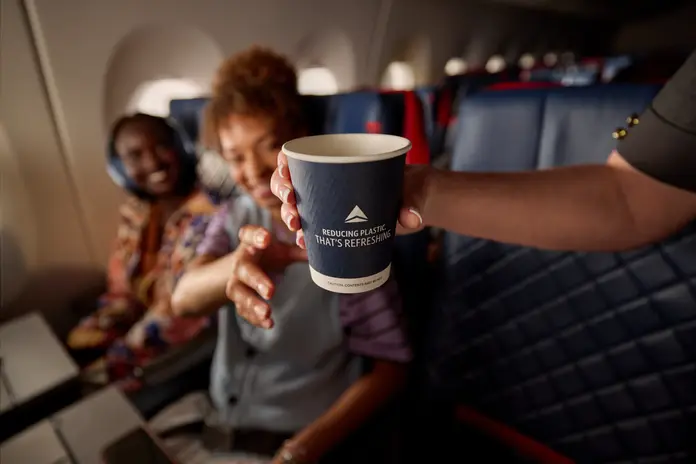
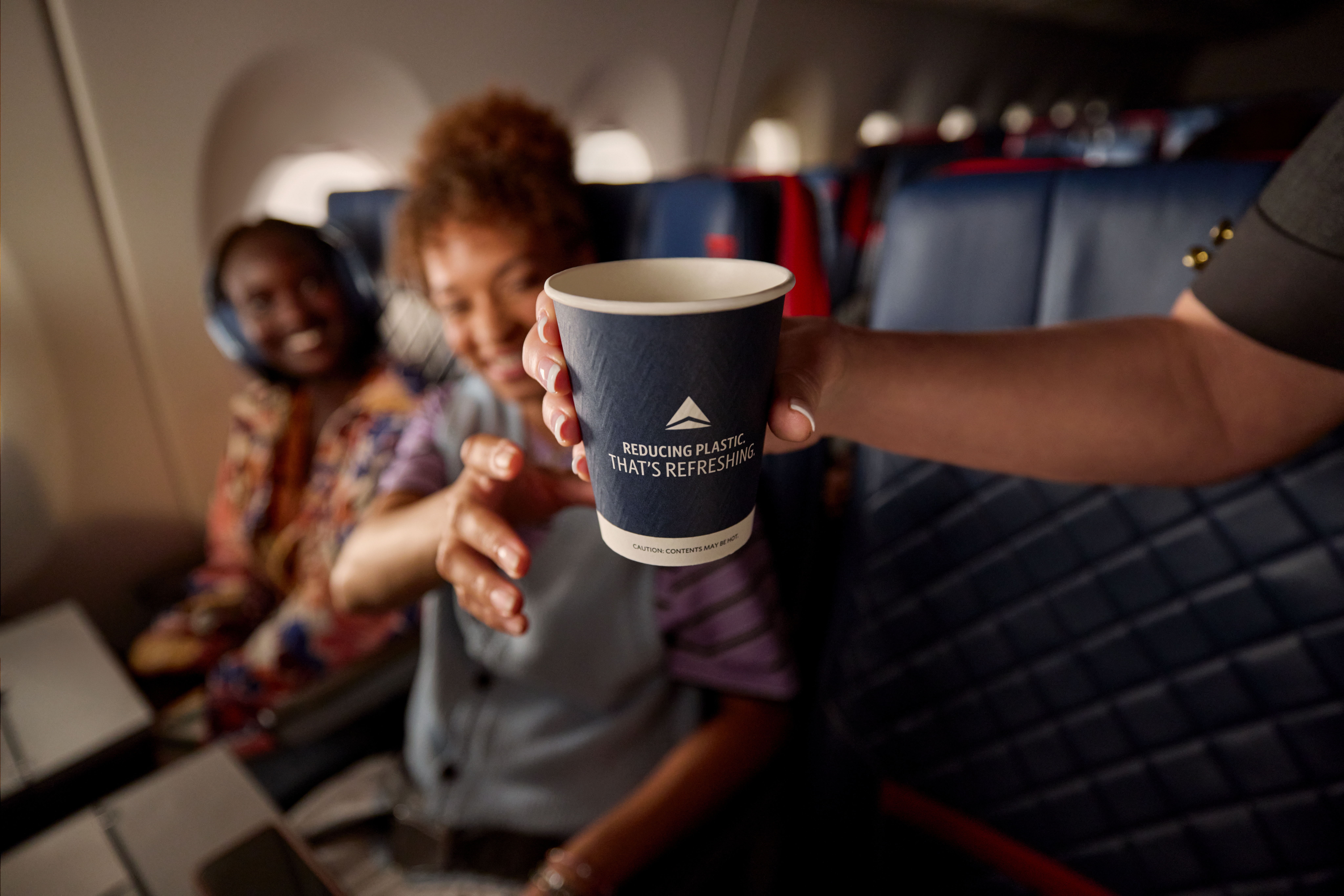
Sustainability on board and on the ground matters, too. This year, Delta officially rolled out new paper cups across its entire operation. Years ago, Delta began the journey to reduce single-use plastics in flight to deliver a more premium customer experience. One major step toward that goal was finding a more sustainable alternative to plastic cups. In 2023, Delta began final testing of these new cups on transcontinental domestic flights. After completing testing in 2024, teams across Delta worked through inventory, supply chain and logistics to make the transition.
Additionally, Delta opened the new Delta One Lounge and a second Delta Sky Club at Seattle-Tacoma International, the entirety of both created with sustainability in mind with features like smart windows that adjust to sunlight, all-electric energy with motion-sensing lights and reusable dinnerware to reduce waste. These thoughtful touches help lower energy consumption while fostering a comfortable and elevated atmosphere.
Finally, Delta continues to support regional flight innovation with a new partnership with Green Taxi Aerospace to explore electric taxiing technology that aims to reduce fuel use, operating costs, taxi time, and carbon emissions. Delta’s Sustainable Skies Lab is contributing decades of operating experience to help Green Taxi optimize its electric taxing system at airports for regional aircraft, though their long-term vision extends is to offer this technology for larger aircraft as well.
Deepening Airbus and Delta's partnership


Delta continues to deepen its relationship with Airbus, positioning the world’s leading aircraft manufacturer and its largest operator at the forefront of advancing next generation aviation technologies to revolutionize the future of flying. Earlier this year at CES, Delta announced a number of initiatives with Airbus, including working with Airbus to test a new flying technique called fello’fly, which takes inspiration from migrating geese and showcases the power of collaboration by pairing flights. With this flying technique, the lead aircraft creates an uplift that drives fuel efficiency for the trailing aircraft, called wake energy retrieval, which can reduce fuel consumption up to 5% for the follower aircraft on long-haul flights.
This fall, Delta took a leading role in the next phase of testing, alongside Airbus and its partners. This trial phase showcased the feasibility of the Airbus Paring Assistance Tool (PAT), demonstrating capability to safely guide two aircraft to meet at a precise time and place, called the rendezvous point, while maintaining full vertical separation and remaining compliant with air traffic regulations. Teams across Delta, including the OCC and Flight Operations, worked together and with participating airlines to showcase the viability of the PAT technology.
Continued inspiration from nature
While fello’fly takes inspiration from geese, Delta’s biomimicry work doesn’t stop there. Earlier this year, Delta added a new partner to its Sustainable Skies Lab that is driving fuel efficiencies inspired by an unlikely source: sharks. MicroTau is an Australian aerospace technology company developing a ‘Riblet Modification Package’ that mimics shark skin to drive drag reduction. This “shark skin” technology can be applied to an aircraft’s fuselage, wings and tail, and once applied, may improve fuel efficiency by up to 4% according to MicroTau’s estimations. Delta is working with MicroTau to ensure their riblet film meets rigorous material-specification requirements prior to installing and testing on live aircraft
Delta is also testing finlets. Finlets are fins, similar to the ones fish have, that can be installed on the back of an aircraft on the fuselage to reshape airflow and reduce drag, ultimately leading to reduced fuel consumption and carbon emissions.
Similarly, Delta has been working for years to add enhanced winglets and lightweight landing gear to its fleet to make them as efficient as possible. Winglets are the curved surfaces seen on the wingtip of aircraft to smooth airflow and reduce drag, allowing aircraft to burn less fuel. Delta finalized the modifications of the split-scimitar winglet upgrade on the 737-800 fleet this year, marking the completion of Delta adding the most advanced winglet technology available to all existing fleets that can be modified.
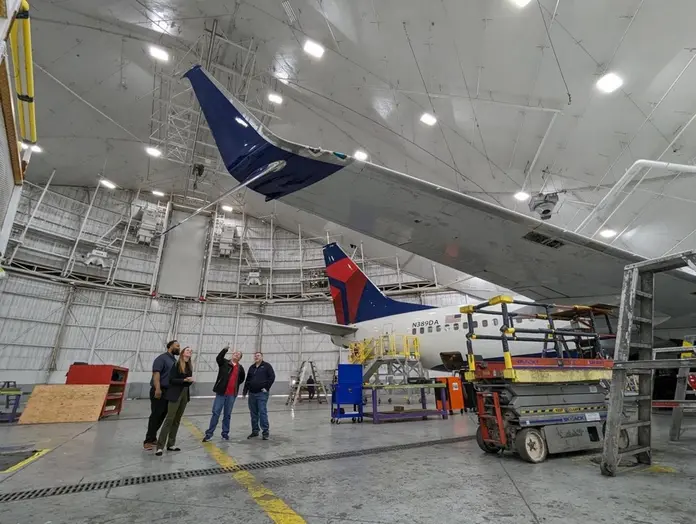
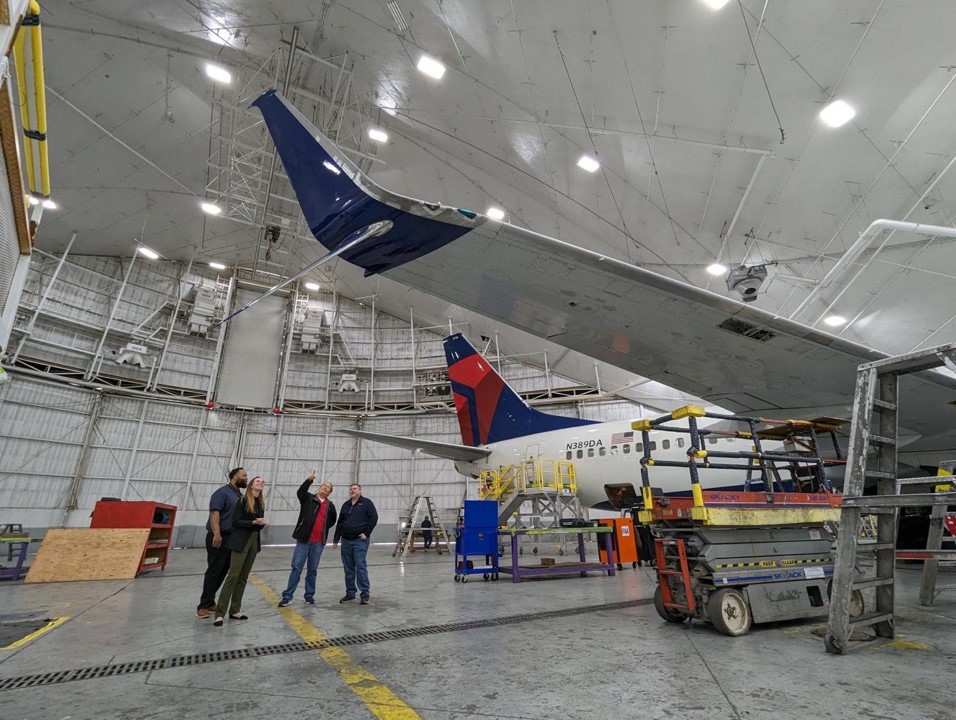
With approximately 90% of Delta’s carbon emissions coming from jet fuel each year, every decision and modification can drive fuel savings that add up, and these decisions are indicative of Delta’s commitment to make changes within its control on its existing fleet, while also purchasing next-gen aircraft that are more fuel-efficient and supporting research into aircraft that will help Delta reach its decarbonization goals.
THE FUEL WE USE
Ongoing efforts to scale sustainable aviation fuel (SAF)
SAF is the most promising lever known today to reduce lifecycle carbon emissions from conventional jet fuel and decarbonize Delta’s operation, and it can help support a robust farming, agriculture, and energy industry that supports economic growth in the U.S. However, there isn’t enough SAF available to meet global demand for even a week. That’s why Delta continues to work across industries and with state and federal lawmakers to enact policy solutions that will allow for the U.S. SAF market to reach scale and flourish.
Roots to Runway SAF
In 2025, Delta is on track to increase its SAF usage by 50% compared to 2024. Additionally, Delta collaborated with key partners, including Shell Aviation, Montana Renewables and the Port of Portland for the first commercial-scale SAF uplift at Portland International Airport (PDX). This marked the first commercial scale SAF uplift at PDX.

Delta Air Lines, in collaboration with Shell and Portland International Airport (PDX), has taken delivery of Sustainable Aviation Fuel (SAF) into the PDX fuel system, marking the first commercial-scale SAF uplift at PDX.
Delta was also named one of the world’s Most Innovative Companies by Fast Company for the fifth time. This time around, Delta was recognized in the No. 3 spot – the only airline ranking – in the Corporate Social Responsibility category for its tangible efforts in scaling SAF.
Finally, Delta re-launched Elevate Your Status for the first time since 2019, with a meaningful update. Through Dec. 31, eligible U.S.-based SkyMiles and Medallion Members can make a one-time MQD purchase to reach the next Medallion tier for 2026, with 100% of proceeds (excluding processing fees*) going to support Delta’s SAF program.
Looking ahead
2025 was a year of action, but the journey continues. From scaling SAF to advancing next-generation aircraft, Delta remains committed to transforming the future of flight, all of which is accomplished by Delta’s 100,000 people that help make this work possible.
© 2026 Delta Air Lines, Inc.